Investment Philosophy
Our investment philosophy is rooted in simplicity and discipline. We believe that successful investing does not require a complicated strategy, but rather a keen eye for quality and a strong sense of value.
Our approach revolves around identifying companies that demonstrate robust financial health, sustainable competitive advantages, and promising long-term growth potential.
Once these high-quality companies are identified, we make investment decisions based on a thorough analysis of their current market prices. We only proceed if the pricing aligns with our strict valuation criteria, ensuring that we are investing in assets that offer a compelling balance of risk and reward.
By buying and selling these companies at prices that make sense, we aim to build a portfolio that not only generates strong returns but also minimises risk exposure. This disciplined strategy allows us to navigate market fluctuations with confidence, focusing on long-term success rather than short-term gains. In essence, our philosophy is about maintaining a straightforward yet effective approach to investing – seeking quality, evaluating value, and making sensible decisions at every step.

Individually Managed Accounts
We specialise in Individually Managed Accounts (IMA) strategies which we believe deliver better outcomes for investors than alternative investment setup Separately Managed Accounts (SMA).
An Individually Managed Account offers:
Ability to retain existing shares
Clients often come to us with small parcels of shares or even fully established portfolios. With an IMA arrangement, we have the flexibility to select and retain specific investments that align with the client’s new portfolio recommendations, even if those assets are not currently part of our existing strategies. This approach allows us to customise each portfolio to the client’s unique circumstances and investment goals.
One of the key advantages of IMAs is that they preserve the client’s original cost bases for their investments, which can provide a more adaptable and strategic approach to tax management. For instance, maintaining the existing cost base can enable clients to manage capital gains more efficiently, potentially minimising their tax liability over time.
In contrast, a SMA requires all existing shares to be sold at the market price before implementing the new investment strategy. This can trigger immediate capital gains or losses and limit the client’s ability to manage their tax exposure effectively. By choosing an IMA, clients gain a more personalised and tax-efficient investment experience, tailored to both their financial objectives and tax planning needs.
Market Timing
Conventional wisdom often suggests that trying to ‘time the market’ is futile, but as value managers, we hold a different perspective. While we agree that predicting short-term market movements is challenging, we also believe it is equally unwise to invest in assets that are overvalued. Our investment strategy is centred around buying assets only when they are priced attractively relative to their intrinsic value.
With IMAs, we have the flexibility to set specific target buy prices for stocks that we find appealing and to halt purchases if those stocks become overvalued. This approach enables us to maintain a disciplined investment process focused on maximising long-term returns while minimising unnecessary risks. For example, a client joining our service six months after a surge in bank stocks will likely have a portfolio that looks quite different from a portfolio established earlier, reflecting current market conditions and valuations.
In cases where assets are overpriced, we prefer to hold the client’s funds in cash rather than invest at inflated prices, as doing so could expose the portfolio to potential capital loss. This ability to stay flexible and patient is one of the key advantages of IMAs.
In contrast, SMAs operate differently. They are typically required to buy and sell assets immediately when new funds are added or when the portfolio is rebalanced, regardless of the current market price of those assets. This rigid structure can result in buying overvalued assets and potentially missing out on better opportunities, underscoring the more dynamic and tailored approach offered by IMAs.
Client Choice
With an IMA, clients have greater control over how their funds are invested, allowing for a highly personalised approach. Whether a client wishes to exclude certain types of investments, such as gambling stocks, or prefers to focus on sectors like renewable energy, we can tailor the portfolio to align with their specific preferences, ethical considerations, and risk tolerance. This level of customisation is particularly valuable for investors who have specific financial goals or want to ensure their investments reflect their personal values.
In contrast, a SMA offers far less flexibility. Clients in an SMA are restricted to a predetermined model portfolio with no input on which individual assets are included or excluded. This lack of customisation means that SMAs may not fully address a client’s unique investment preferences or adapt to changes in their financial situation over time. By choosing an IMA, clients can be more engaged in the investment process, ensuring that their portfolio evolves with their goals and market opportunities.
Individual Tax Outcomes
With IMAs, we tailor each client’s portfolio to their specific circumstances, resulting in unique tax outcomes. This personalised approach allows us to strategically buy or sell assets based on individual needs and financial goals.
For example, we can focus on securing investments with high franking yields, which can be particularly advantageous for high-income earners seeking to maximise their after-tax returns. Alternatively, for clients holding assets with significant capital gains, we have the flexibility to sell these assets gradually over multiple tax years. This approach helps to manage and potentially reduce the tax impact, optimizing their overall financial position.
By customising investment strategies to align with each client’s unique tax situation, IMAs offer a level of flexibility and control that is not possible with more standardized investment options. This individualised management can be crucial in enhancing after-tax returns and supporting long-term wealth-building strategies.

Investment Research
Our preferred method as stock pickers is rooted in thorough and meticulous research.
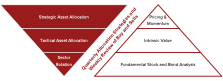
We utilise a blend of both top-down and bottom-up research to uncover compelling investment opportunities.
The top-down approach involves analysing the broader economic environment, global market trends, and sector dynamics to identify promising areas for investment. This helps us understand the macroeconomic factors that may impact various countries and industries.
Simultaneously, our bottom-up process focuses on evaluating individual companies within these sectors. We conduct in-depth research into a company’s financial health, management effectiveness, competitive advantages, and growth potential. By combining these two complementary approaches, we aim to build a well-rounded portfolio that capitalizes on both macroeconomic trends and company-specific strengths.
Unlike many investors who look for specific catalysts or short-term triggers that could push a stock’s price higher, we are not concerned with these temporary factors. Instead, we focus on finding investments that offer sheer, undeniable value. When we spot such opportunities, where the market significantly undervalues a company’s true worth, we don’t need any further justification to invest. For us, the presence of outrageous value itself is a strong enough signal to act, providing a margin of safety that aligns with our long-term investment goals.
We place minimal emphasis on the overall state of the market and impose very few restrictions on our investment choices. Our focus extends across the entire spectrum of companies – whether they are large-cap, mid-cap, small-cap, micro-cap, tech, or non-tech. To us, the type or size of the company is irrelevant as long as we can identify value within it, and we can be confident these is liquidity. If we see a company that offers genuine value, it immediately becomes a potential candidate for our portfolio.
Setting arbitrary limits on our investment possibilities seems impractical. Instead, we aim to remain flexible and open to opportunities wherever they arise. Over the years, we have observed that the market often behaves irrationally, discarding valuable assets indiscriminately, akin to ‘throwing the baby out with the bathwater.’ This market behaviour can create unique opportunities for those who are willing to dig deeper and identify hidden value in overlooked sectors or companies. By adopting this flexible approach, we can build a diverse portfolio that captures opportunities across various market conditions.

Strategic Asset Allocation
Strategic Asset Allocation (SAA) plays a crucial role in determining a portfolio’s long-term exposure to various systematic risk factors.
Strategic Asset Allocation (SAA) relies on historical data, including long-term return forecasts and the standard deviation for each asset class over a 20-year period. By focusing on long-term trends and patterns, the SAA framework aims to establish an optimal balance between risk and return, providing a foundational structure for investment decisions.
To achieve this balance, we use a mean-variance optimisation model. This model helps identify the most efficient mix of assets that offers the best possible return for a given level of risk. Qualitative adjustments are made to capture additional asset class characteristics not accounted for in a quantitative process such asset class liquidity, market depth and investability.
The establishment of the SAA is a deliberate process which is reviewed on an at least annual basis by our investment committee. The outcome of the SAA process is a set of portfolio weights for each asset class.
By assessing each client’s unique risk tolerance and investment goals, we tailor the asset allocation strategy to maximise potential returns while minimising unnecessary volatility. This disciplined approach ensures that portfolios are designed to meet each client’s long-term financial objectives.

Tactical Asset Allocation
Tactical Asset Allocation (TAA) tries to exploit the deviation of asset-class values from the expected long-term relationship as well as the perception of disequilibria.
The SAA serves as a benchmark that specifies the appropriate asset mix given long-run considerations. But in the short-term markets deviate from long-term expectations and our Tactical Asset Allocation (TAA) tries to exploit the deviation of asset-class values from the expected long-term relationship as well as the perception of disequilibria.
The TAA represents any short-term ‘tilts’ the investment committee wants to apply to the SAA in either asset classes or investment styles.
The process seeks to add value over short to medium-term horizon, broadly 6-18 months. TAA seeks to position portfolios to take advantage of market dislocations and investment opportunities which arise at different points of a market cycle.
This process is managed and reviewed on a quarterly basis by the House of Wealth Investment Committee
Key inputs into the TAA process:
- Macroeconomic and market themes
- Economic data
- Short- and medium-term financial market indicators
- Asset class valuations
At each quarterly Investment Committee meeting, TAA positions are implemented for each client expressed as an asset class over/underweight relative to the SAA.

Sector Rotation
Different sectors are stronger at different point of the economic cycle.
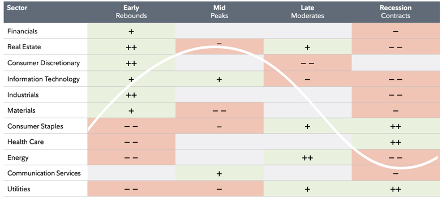
The varying performance of business sectors throughout different phases of the economic cycle creates unique investment opportunities. Our market / economic cycle model is based on the work of Sam Stovall in his book S&P’s Guide to Sector Rotation. The basic premise is that different sectors are stronger at different point of the economic cycle.
By analysing sectors on a relative basis against the All Ords (or other international indices) we can gain insights into what sector are going to lead the charge.
Each business cycle has its own distinct characteristics, and the relative performance patterns among equity sectors can differ significantly from one cycle to another. Recognising which sectors are likely to outperform is crucial, but it is equally important to identify those that consistently underperform.
Investors can leverage sector investing to strategically position their portfolios in anticipation of shifts in the business cycle. By closely monitoring the economic environment and understanding how different sectors react to changes, investors can make informed decisions about where to allocate their capital for optimal returns. For instance, during periods of economic expansion, sectors like technology and consumer discretionary may outperform, while during downturns, defensive sectors such as utilities and healthcare might offer stability.
Successful investing is not just about picking the right individual stocks; it’s also about understanding the broader economic context and aligning your sector choices with the anticipated phase of the business cycle. This proactive approach can help investors mitigate risks and capitalise on growth opportunities as market conditions evolve.

Intrinsic Value
Intrinsic value is the real value of a company or an asset. It can be below or above the market price.
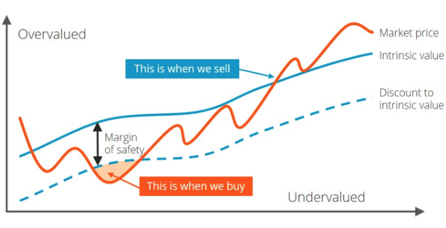
We believe that having a deep understanding of a company’s intrinsic value is critical before committing any capital to an investment. This approach is not something we chose on a whim; it was more of a natural progression for us after encountering the influential writings of Benjamin Graham. From that moment, it felt as though we were destined to take on the role of value investors.
Graham’s principles, particularly those outlined in his seminal work ‘Security Analysis,’ which he co-authored with David Dodd, formed the foundation of our investment strategy. One core concept that resonated with us was the ‘margin of safety.’ This idea suggests that an investor should only buy securities when they are priced significantly below their estimated intrinsic value. By doing so, there is a built-in buffer against errors in analysis, market volatility, or unforeseen events that could negatively impact the investment.
Over the years, we have refined these techniques to suit our own investment style and objectives. However, the central tenet remains unchanged: our primary aim is to protect our downside and prevent the permanent loss of capital. We adopt a conservative approach because, in the world of investing, the preservation of capital is just as crucial, if not more so, than seeking high returns.

Address
42-44 Urunga Parade
Miranda NSW 2228
(02) 9531 6240
info@cornerstoneadvice.com.au